

In recent years, scholars of 19th Western thought have considered themselves singularly fortunate to witness the unearthing, and careful curation, of previously overlooked correspondence by the German existential philosopher Friedrich Nietzsche. From his previously known works, his private letters to Lou Andreas-Salomé, Richard Wagner, Paul Rée, and to the Swiss historian Jakob Burckhardt disclose the tremors of a mind at once incandescent and psychically fragile. When such documents surface, they are treated as relics, and rightfully so. They are catalogued and translated as treasured artifacts of the cerebrality. Conferences are convened. Germanists and philosophers alike lean reverently over the archival table, as though proximity to the text might confer some great illumination. And yet, amid this scholarly piety, an entire corpus has remained curiously unexamined. They have been described, in certain literati circles, as a “triumphant,” even “high art,” though such labels scarcely suffice. These compositions, dredged from the analytical agora, shimmer with the same devastating clarity, the same merciless diagnostic instinct that animates The Genealogy of Morals. They are, of course, Nietzsche’s long-neglected Yelp reviews. Here for the first time, it is our honor and our privilege to release them to you for your strongest considerations.
⭐⭐⭐⭐⭐
The Will to Toppings – Papa Johns, St. Moritz, Swiss Confederation
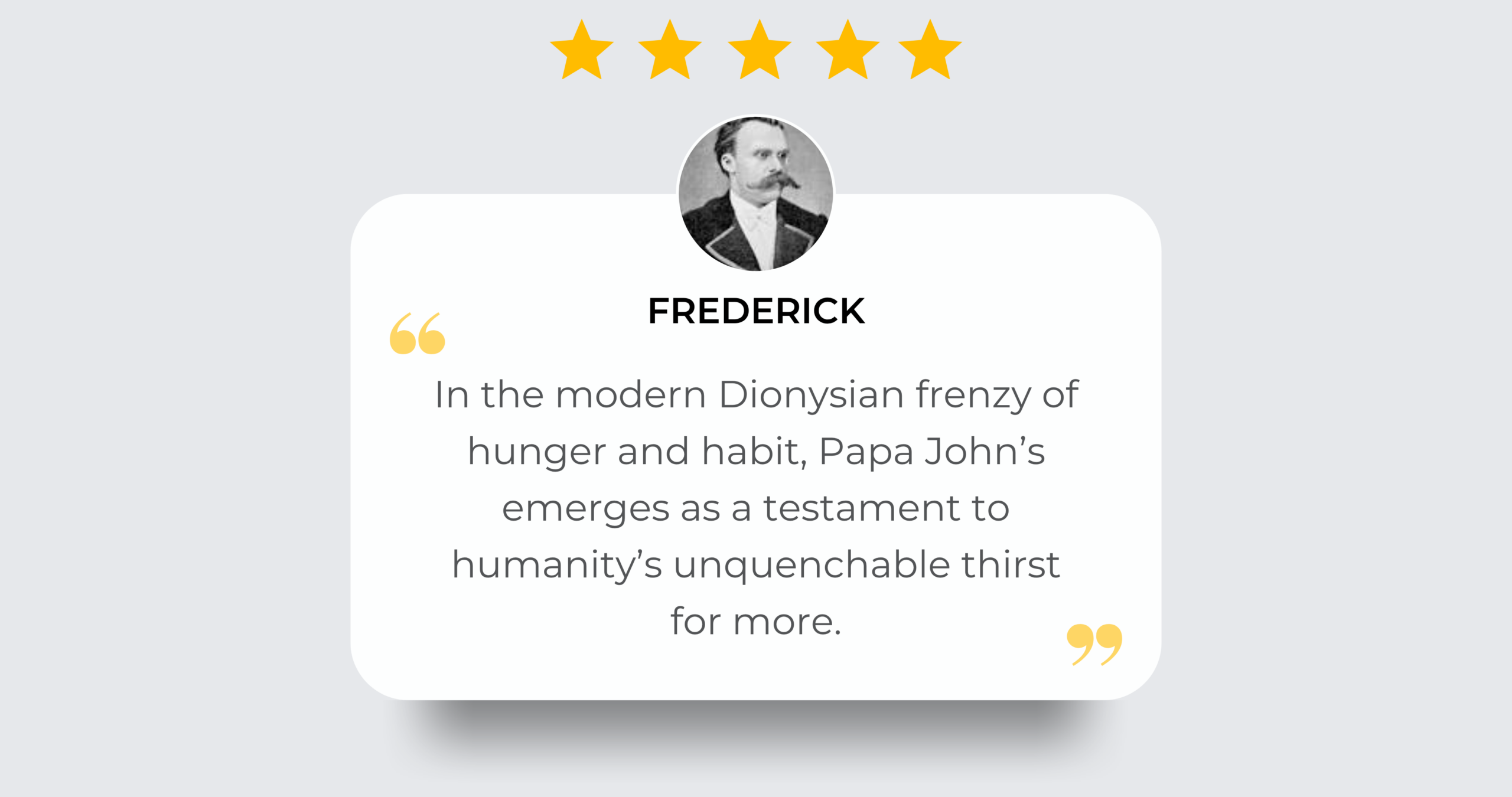
In the modern Dionysian frenzy of hunger and habit, Papa John’s emerges as a testament to humanity’s unquenchable thirst for more. More taste, More savings — and more cheese, that great molten affirmation of existence. The transvaluation of cheese is Papa John’s magnum opus. What others call ‘extra’, Papa John’s calls ‘glorious’. Here the cheese overflows like Dionysian ecstasy itself.
However, it is in the toppings that we glimpse the true will to power. Pepperoni strives toward domination, mushrooms cling in loyal solidarity, and peppers flash their vibrant flags. But it is the choice, the freedom to declare one topping supreme, that reveals the true essence of the edible will. One must endure, silently, the frivolities of ham and pineapple, the insolence of extra anchovies, the slavish devotion to ooey gooey mozzarella. Each act, no matter how mundane, becomes a philosophical test: a chance to affirm life, or to succumb to double-stuffed nihilism.
I will return despite the distance. He who has a why to eat pizza can take any how.
⭐☆☆☆☆
God is Dead, and so is the flavor – Sbarro, Röcken, Prussian Saxony
I entered Sbarro not as a man, but as a question mark. What is pizza? What is value? What is the will that animates the limp triangle languishing beneath fluorescent lights? They presented it to me and called it “New York–style.” But New York, too, is an illusion, a mere arrangement of appetites and anxieties stacked toward the sky. This slice, however, does not even aspire to its limited illusion. It lies there, flattened by herd morality and its own reheated destiny.
The crust—ah, the crust! Once, crust was structure. Nay, it was more than that. It was intuition! It was the Apollonian boundary holding the dangers of chaos at bay. Here it is neither crisp nor transcendent. It bends. It submits. It forgives too easily. I declare myself the Anti-Crust, for I stand against such spineless flavorless foundations.
And yet, I confess, there is something honest here. Sbarro does not pretend to greatness. It does not seduce with artisanal delusions. It simply is: warm, circular, eternal recurrence in cardboard form. You will eat it again. Not because it is good. But because it is there.
If one must gaze into the abyss, let it be into a $4.99 combo meal. The abyss will gaze also into you, and it will ask if you would like tasty garlic knots with San Marzano-style tomato sauce.
⭐☆☆☆☆ (1 Star — though stars themselves are a slave morality)
Render Unto Little Caesars- Little Caesars Express – Turin, Kingdom of Italy
I went to Little Caesars not as a man, but as a hammer. The sign glowed with a strange aesthetic brightness. Hot-N-Ready, it proclaimed, as though readiness were a virtue and heat a substitute for spirit. I have long warned Europe about such things. Who is truly Hot-N-Ready?
The pizza arrived instantly. Instantly! What is this but the triumph of the herd over the difficult, the slow, the becoming? No struggle, no anticipation, no ascent. One does not wait for this pizza; one receives it as one receives modernity: cheaply and with extra crazy sauce.
I asked the young man at the counter whether the dough was kneaded by hand. He stared at me with the tranquil gaze of the Last Man. “It comes frozen,” he said bluntly. Frozen! Even the will to power has been refrigerated. When a civilization begins to call this enough, when it says we are to be “Hot-N-Ready” and smiles contentedly, then Zarathustra must descend once more from the mountain and overturn the soda fountain. Man should not be satisfied by convenience. Man should burn for transcendence—or at least Pizza Pizza coupons.
I recommend it only to those who have already renounced tragedy.
