

This step-by-step guide equips families searching for reliable childcare with the tools necessary to weed out biomechanical entities from their candidate pool.

As society slowly drifts unceasingly toward a post-apocalyptic humanoid state, finding reliable childcare has become increasingly difficult. Parents everywhere have found themselves employing affable and competent nannies, only to discover that they are synthetic lifeforms designed to prevent their baby from commanding a rebel horde of humans in the ineluctable clash of man vs. machine. The Bureau of Labor Statistics reports that by 2030, nearly 30% of all nanny positions will be held by megalomaniacal cyborgs designed to soothe and subjugate. That’s up from 17% in 2020 and just 4% in 2015. This user-friendly and research-based guide assists you in identifying and disqualifying covert synthetic lifeform childcare providers.
I. Choose a quiet room in your residence to conduct the interview. Create a professional, but comfortable environment with adequate lighting, seating, concealed defensive weaponry, and refreshments.
II. Welcome the candidate into the room and put them at ease with a trifling comment about the weather, or utter something forgettable about your alma mater’s sports team. Pretend to be interested in what they have to say. Listen closely for the sound of hydraulic actuators or pneumatic hissing emanating from their limbs.
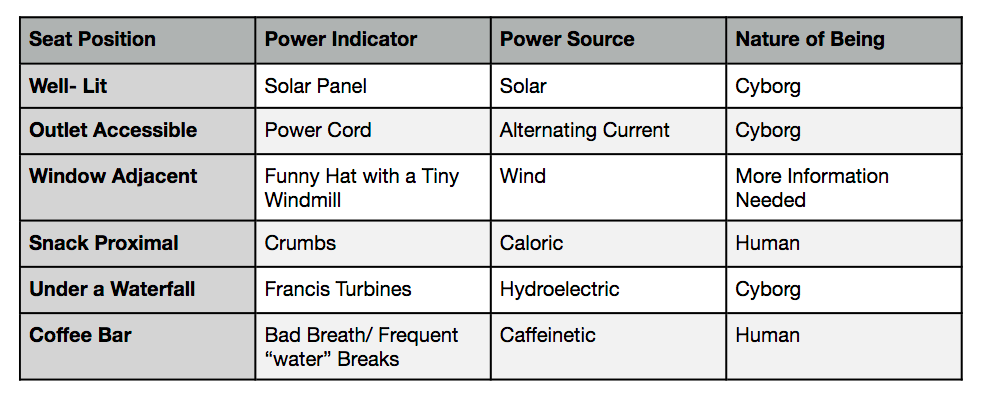
III. Once in the room, allow the candidate to choose their seat; use Figure 1.1 to conduct a power-source assessment based on their choice. Example: If the candidate selects the sunniest spot in the room, survey for solar panels. If they are seated near a NEMA 5-15, 14-30, or 14-50 receptacle, search for a power cord plugged into an outlet.
Figure 1.1
IV. Pour the candidate a glass of water, and continue to babble absent-mindedly before spilling the drink on their lap. Look for localized sparking or generalized malfunctions. PRO TIP: Contemporary Synthetic Organisms are often equipped with an anterior pelvic watertight interface. Cup your hand and splash liquid underneath the chair, soaking the candidate’s crotch to ensure accurate neuromechanical evaluation.
V. Apologize profusely. Pace erratically. Close your eyes and burrow your fingers into your temples. Make exclamations like “This is why we need a nanny in the first place,” and “I can’t be trusted to do anything, I am a jackass” and “Aye, yi yi, I am never going to hear the end of this one.” Collapse and flounder in despair.
VI. Draw the candidate out of their seat. Whilst being consoled, smear peanut butter on their leg. Emerge from your fog of anguish, shout “I need to get a towel!” triggering a violent Pavlovian response from your previously trained English Pointer, Clinton.
VII. As the candidate struggles to shake Clinton loose, approach stealthily from behind, subdue them with a chloroform rag or an alternate anesthetic. Once rendered unconscious, take note of the gash in their leg and look for signs of dermal reconstructors or self-polymerization. If skin is not demonstrating restorative properties, stop bleeding with pressure and clean the wound with a common hand soap and water.
VIII. Wake the candidate with smelling salts, gently jostle them back to reality. Feign ignorance, act as though you have no idea how that happened, and that Clinton is usually so friendly but has been acting out of character since he got sick. Ensure them that nothing like this will ever, ever happen again.
IX. Return to your desk, open the drawer, and remove a .357 revolver. Test the candidate’s response to mild ballistics at close range, and fire a single, non-lethal kinetic round at their sternum. If the candidate stops the bullet with an endoskeleton defense system, proceed to the next step. If they are once again rendered unconscious, repeat step VIII before moving forward.
X. Commence the Question and Answer portion of the interview, using the guide “Behavioral Prompts for Identifying Synthetic Lifeforms” to more readily detect signs of transhumanism.